
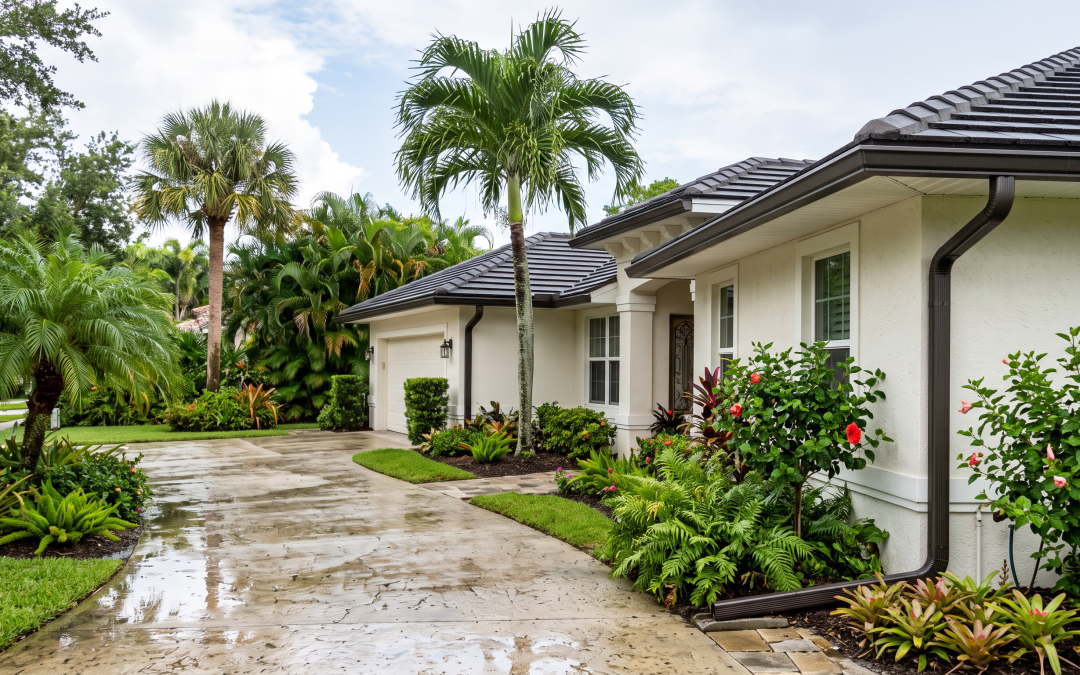
Putting up gutters on a Central Florida home is the single most effective exterior upgrade for preventing foundation erosion, fascia rot, and severe water intrusion during intense tropical downpours. By collecting roof runoff and directing thousands of gallons of water safely away from concrete slabs and sandy soil, an engineered gutter system preserves structural integrity and prevents costly exterior damage across Dade City, Lakeland, and Tampa communities.
- Massive Water Diversion: A standard 2,000-square-foot roof sheds roughly 1,250 gallons of water for every single inch of summer rainfall, making controlled drainage mandatory.
- Slab and Soil Defense: Florida sandy soils erode quickly under unchanneled roof waterfalls, leading to compromised slab footings, sunken driveways, and cracked stucco.
- Custom Engineering: Professional installations utilize seamless 6-inch or 7-inch aluminum profiles pitched at a precise slope to handle intense storm volume without overflowing.
The Hidden Impact of Florida Rainfall on Residential Foundations
Living in Central Florida means experiencing intense weather patterns, where sunny mornings often give way to torrential afternoon cloudbursts and late-season tropical storm systems. When a residential property lacks a dedicated roof water management system, every downpour sends thousands of gallons of water cascading directly off eaves onto the surrounding perimeter.
Most homes across Pasco County, Polk County, and Hillsborough County are constructed on monolithic concrete slab foundations set over porous, sandy soil. While sandy terrain allows surface water to absorb rapidly at first, high-volume cloudbursts quickly saturate the ground immediately adjacent to exterior walls. Once the soil reaches its saturation point, hydraulic pressure builds against the slab edge.
Over time, this repeated water dumping causes soil compaction imbalances and subterranean washouts. As soil erodes from beneath the perimeter footings, concrete slabs can settle unevenly, resulting in interior drywall cracks, sticking doors, exterior stucco fractures, and pooling water beneath floor coverings.
Recent industry data highlighted in a Clean Pro Gutter Cleaning maintenance study showed that over 44% of homeowners face roof-edge drainage maintenance delays exceeding a year right as peak storm activity approaches, leaving residential foundations vulnerable to preventable damage.
The Rise of High-Capacity Water Management in Modern Home Construction
Historically, many Florida subdivisions were built without full gutter systems to reduce initial construction expenses. Builders assumed wide roof overhangs and sandy ground would adequately disperse roof runoff. However, decades of structural evaluations and storm assessments have proven that unmanaged runoff creates severe long-term building envelope decay.
Modern building science emphasizes continuous, closed-loop water diversion from roof peak to safe discharge zones. The evolution of residential exterior design has shifted focus toward heavy-gauge seamless aluminum systems designed specifically to handle high-velocity rain events. By capturing rainfall at the eave before it contacts siding, windows, or landscaping, modern systems safeguard the complete building envelope.
| Feature | Traditional Sectional Gutters | Custom Seamless Gutters |
|---|---|---|
| Joint Frequency | Seams every 10 to 12 feet | Continuous single runs corner-to-corner |
| Leak Risk | High at degrading seam sealant joints | Minimal, restricted only to corners and outlets |
| Debris Catch Points | Frequent internal screw heads and overlapping joints | Smooth interior channel for uninterrupted flow |
| Wind & Weight Resistance | Prone to pulling apart under heavy storm loads | Strong structural integrity mounted with heavy-duty hidden hangers |
Putting Up Gutters in Practice: Sizing, Slope, and Installation Standards
Properly putting up gutters requires precise mathematical calculation and structural anchoring. A poorly planned installation will fail during the first heavy thunderstorm, either overflowing along the front lip or sagging under the weight of surging water.
1. Sizing for High-Volume Tropical Downpours
While standard 5-inch gutters may work in regions with light, continuous drizzle, Central Florida homes demand 6-inch or 7-inch K-style or half-round configurations. A 6-inch gutter carries approximately 40% more water volume than a 5-inch profile. When paired with oversized 3×4-inch downspouts, the system easily drains steep-pitch roofs without backing up under shingles.
2. Calculating Slope and Pitch
Water must move steadily toward downspout outlets without standing in stagnant pools that attract mosquitoes or breed algae. Professional technicians maintain a slope ratio of approximately 1/4 inch of drop for every 10 feet of horizontal gutter run. This subtle angle ensures rapid velocity while keeping the roofline visually level and appealing.
3. Secure Fascia Mounting and Hidden Hanger Spacing
Heavy water loads exert tremendous torque on fascia boards. Professional installation involves driving heavy-duty screw-in hidden hangers directly through the fascia and deep into rafter tails. In storm-prone regions, hanger spacing should not exceed 24 inches on center, with even tighter 18-inch spacing applied in high-wind corner zones.
- Expansion and Contraction Tolerance: Heavy-gauge aluminum expands and contracts with daily Florida sun exposure; proper relief joints prevent warping.
- Fascia and Soffit Inspection: Mounting brackets must always attach to sound, rot-free wood. Damaged fascia boards must be replaced prior to hanging new channels.
- Strategic Downspout Placement: Downspouts must be placed every 30 to 40 feet of gutter run and terminate at least 5 to 6 feet away from the foundation footings.
Tailored Solutions for Central Florida Properties
Every home presents unique structural factors that influence gutter design. When planning a custom water diversion system, several property-specific variables must be evaluated:
- Roof Size and Pitch: High-pitch roofs accelerate runoff speed, requiring larger 6-inch or 7-inch troughs with splash guards in high-volume valleys.
- Tree Canopy Coverage: Properties shaded by live oaks, pine trees, or palms benefit substantially from integrated micro-mesh leaf protection to keep downspouts clear.
- Lanai and Pool Enclosure Tie-Ins: Central Florida pool cages require specialized super-gutter integration to bridge rooflines and screen structures seamlessly.
- Landscape Drainage Gradients: Properties with flat yards require underground drain pipe extensions or pop-up emitters to channel discharge into designated swales.
Why Central Florida Homeowners Choose Taylor Gardner Gutters & Exteriors
Based in Dade City, FL, Taylor Gardner Gutters & Exteriors provides dependable exterior drainage and protection services for homeowners and commercial property managers throughout Hillsborough, Pasco, Hernando, and Polk counties. As a fully licensed, insured, and veteran-owned local contractor with an A+ BBB rating, our team delivers superior craftsmanship built on honesty and reliable service.
Our comprehensive exterior services include:
- Custom on-site seamless gutter fabrication and installation (6-inch and 7-inch profiles)
- Comprehensive gutter repair, realignment, and preventive maintenance
- High-performance gutter protection and micro-mesh screen systems
- Soffit and fascia board repair and complete replacement
- Pool and patio screen repair and super-gutter restoration
We take pride in honoring our community by offering a 10% discount for military service members, veterans, and first responders, along with dedicated introductory offers for first-time clients.
Frequently Asked Questions About Putting Up Gutters
How do I know if my home needs new gutters or just repairs?
If your existing channels have minor seam leaks or loose brackets, targeted repair and resealing may restore function. However, if you observe widespread sagging, split corners, water stains behind the fascia boards, or undersized 5-inch troughs that consistently overflow in typical afternoon showers, putting up new 6-inch seamless gutters is the most cost-effective long-term solution.
What gutter material is best for the humid Florida climate?
Heavy-gauge seamless aluminum is the gold standard for Florida properties. Aluminum will never rust, resists corrosion from humidity and airborne salt, and features durable baked-on enamel finishes that resist peeling, cracking, and fading under intense UV exposure.
How far should downspouts extend away from my foundation?
Downspout discharge should release water at least 5 to 6 feet away from your home’s foundation slab. In tight lot layouts across Tampa or Lakeland neighborhoods, burying downspout extensions to carry water out to the street or a backyard drainage swale is highly recommended.
Can installing gutters protect my soffit and fascia boards from rotting?
Yes. When gutters are absent or overflowing, surface water clings to the roof edge and wicks upward into the wooden fascia and plywood soffits. Properly installed gutters with drip edge flashing direct all roof water into the trough, keeping wood framing dry and rot-free.
Protect Your Home with Expert Exterior Solutions
Investing in high-quality gutters is essential to safeguarding your property’s value, landscaping, and structural foundation against the elements. Whether you need a brand-new seamless installation in Lakeland, fascia repairs in Dade City, or storm drainage enhancements in Tampa, Taylor Gardner Gutters & Exteriors provides the reliable expertise and veteran-backed work ethic your home deserves. Contact our team today to schedule your complimentary exterior consultation and protect your home for years to come.